The hidden cost of digital asset management: Is poor asset management draining your marketing budget?
7 DAM KPIs that prove whether your digital asset management really delivers value
Where marketing teams lose 8 hours a week (and how to get them back)
Every image, video, product photo, campaign asset, and marketing material your organization creates represents an investment. Time, resources, and money go into producing content that supports your brand, marketing, sales, and customer experience.
But what happens after that content is created? Is it easy to find? Can different teams access and reuse it? Does it move smoothly between your systems and channels? Or does it get buried in folders, recreated unnecessarily, and forgotten after a single campaign? For many organizations, the real cost of digital content isn’t just what they spend creating it. It’s also what they lose through inefficient content management. And these hidden costs can add up surprisingly quickly.
In this article, we’ll explore where inefficient digital asset management creates unnecessary costs, how to measure its impact, and how organizations can improve the return on their content investments.
The hidden costs of inefficient content management
Content management inefficiencies rarely appear as a single, obvious expense. Instead, they’re scattered across everyday workflows, often becoming so familiar that teams no longer question them. Let’s look at five common areas where organizations lose time, resources, and money.
1. Time wasted searching for digital assets
Think about how often someone in your organization asks: Where can I find the latest version of this presentation? Do we have an approved image for this campaign? Who has the original product photos? Has this material already been translated?
When digital assets are scattered across shared drives, email conversations, cloud storage, and individual devices, finding the right content becomes unnecessarily complicated. Even a few minutes spent searching each day can translate into hundreds of hours of lost productivity annually. And the cost isn’t limited to the person searching. When employees need to ask colleagues for help locating assets, the interruption affects multiple people.
2. Creating content that already exists
One of the most overlooked costs of inefficient content management is duplicate content production. Imagine a marketing team preparing a new campaign. They need a specific product image, but can’t find the one created six months earlier. Instead of reusing it, they commission another photoshoot, purchase a new stock image, or ask a designer to recreate the material.
The organization ends up paying twice for essentially the same content. This becomes especially expensive in larger organizations where different departments, business units, or local markets produce similar materials independently.
Without a centralized view of available assets, teams may not even realize that the content they need already exists.
3. Manual content distribution across channels
Creating an asset is only one part of its lifecycle. It also needs to reach the right people, systems, and channels. For example, a new product image might need to be uploaded to an ecommerce platform, shared with distributors, added to a website, delivered to sales teams, and distributed to international markets.
When these processes rely on manual downloads, uploads, email attachments, and file transfers, each additional channel creates more work. Manual distribution also increases the risk of human error. Files may be uploaded incorrectly, metadata can be lost, and updates may not reach every channel.
4. Slow review and approval processes
Content often passes through several people before publication, including designers, marketing managers, legal teams, and external partners. Without a clear workflow, feedback can become scattered across emails, chat messages, and multiple file versions. Teams may struggle to identify which version is approved, who is responsible for the next step, or whether the latest changes have been implemented.
These delays don’t just consume working hours. They can also slow down campaigns, product launches, and time-sensitive communications.
The overlooked cost of content that is only used once
Organizations invest significant resources in producing high-quality content. Yet once a campaign ends or a project is completed, many of those assets disappear into digital archives. This creates a particularly interesting question: Are you getting the full value from the content you’ve already paid to create?
Consider a product photoshoot that costs €5,000. If the images are used for one campaign and then forgotten, the organization has captured value from just one use case. But what if those same images could be reused across product pages, sales presentations, distributor portals, social media, newsletters, and future campaigns? The original production cost remains the same, but the organization generates more value from the investment.
Of course, not every asset is designed to be reused indefinitely. Some materials are campaign-specific, time-sensitive, or subject to usage restrictions. But many evergreen assets have much greater potential than their initial use suggests.
Why does content reuse remain so low?
Often, the problem isn’t a lack of useful content. It’s a lack of visibility. Assets may be difficult to find, poorly categorized, stored in disconnected systems, or missing essential information about their intended use. When employees can’t confidently find and identify existing materials, creating something new can feel easier than searching for something old. This creates a cycle of unnecessary content production:
Content is created → used once → becomes difficult to find → similar content is created again.
A modern digital asset management (DAM) system helps break this cycle by making content searchable, accessible, and reusable throughout its lifecycle. AI-powered search and automatic metadata enrichment can make this even more effective by helping employees discover relevant assets without needing to know exact filenames or folder locations.
Measuring content reuse
One useful KPI is the asset reuse rate, which measures how often existing content is used across multiple projects, campaigns, or channels. For example:
Asset reuse rate = (Assets reused at least once ÷ Total eligible assets used) × 100
If 200 assets were used during a reporting period and 80 of them had been used previously, the reuse rate would be 40%. This metric can help organizations understand whether their existing content investments are being utilized effectively. However, reuse rate shouldn’t be evaluated in isolation. A highly reusable product image and a one-time event announcement naturally have different lifecycles.
The goal isn’t to reuse every asset. It’s to ensure valuable content doesn’t go unused simply because nobody can find it.
What is inefficient content management actually costing your organization?
Let’s turn these inefficiencies into numbers.
Imagine an organization with 20 employees who regularly work with digital assets. Each employee spends an average of 15 minutes per working day searching for materials, requesting files from colleagues, or performing unnecessary manual content-related tasks.
Assuming 220 working days per year:
| Metric | Value |
| Employees working with digital assets | 20 |
| Time lost per employee per day | 15 minutes |
| Working days per year | 220 |
| Total time lost annually | 1,100 hours |
| Estimated cost per working hour | €40 |
| Annual productivity cost | €44,000 |
That’s €44,000 worth of working time annually spent on activities that could potentially be reduced through better content management. And this example only considers time. It doesn’t include duplicate photoshoots, unnecessary content production, delayed campaigns, corrections caused by outdated materials, or other operational inefficiencies. The actual impact may therefore be considerably broader.
From hidden costs to measurable ROI
Investing in digital asset management shouldn’t be evaluated solely based on software costs or the number of features available. The more important question is: How much inefficiency can your organization eliminate, and what is that improvement worth?
The return on investment (ROI) of DAM can come from several sources:
- Time savings: Employees spend less time searching for files, requesting materials, and completing repetitive tasks.
- Reduced content production costs: Existing assets are reused instead of recreated unnecessarily.
- Faster content distribution: Automated workflows reduce manual transfers between systems and channels.
- Less rework: Centralized version control and permissions reduce the risk of outdated or incorrect materials being used.
- Improved content utilization: Organizations generate more value from the assets they have already invested in.
- Faster time to market: Teams can launch campaigns, publish product information, and deliver materials to partners more efficiently.
A simplified ROI calculation compares the financial benefits of improved content management with the total cost of the solution. Download our DAM ROI guide here.
Which KPIs should you track to measure content management efficiency?
Understanding the costs of inefficient content management is the first step. The next is measuring whether your processes are actually improving. Here are six practical KPIs worth considering:
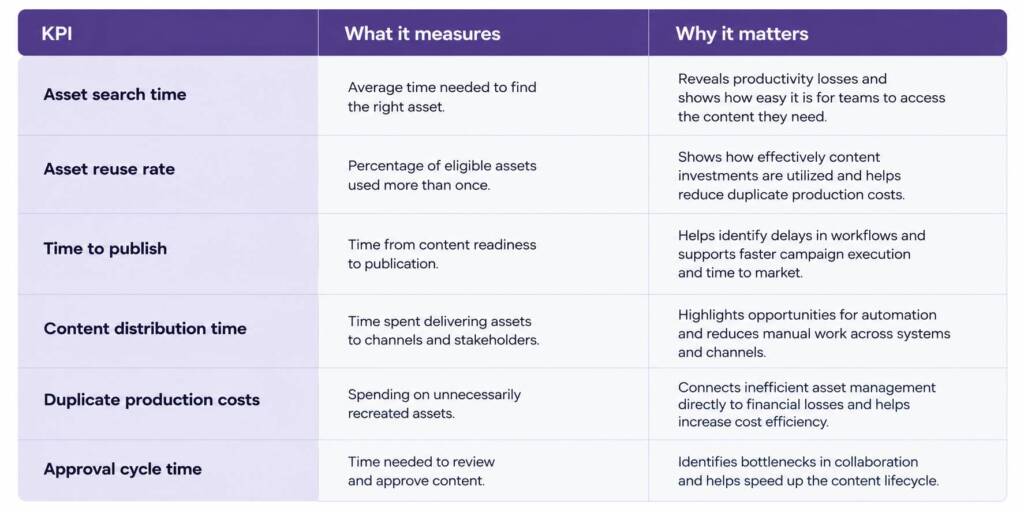
Not all these metrics need to be tracked from day one. A good starting point is to identify two or three areas where your organization currently experiences the most friction. For example, if employees frequently struggle to find assets, start by measuring search time. If your organization produces large volumes of marketing content, asset reuse and duplicate production costs may be more relevant.
The most valuable KPIs are those that connect everyday content operations to broader business objectives. Read more here.
How AI and connected workflows can improve content ROI?
Centralizing digital assets is an important first step, but simply storing everything in one place doesn’t automatically eliminate inefficient workflows. The real value comes from making content easier to find, reuse, manage, and distribute. This is where AI-powered DAM and connected content ecosystems can make a significant difference.
AI-powered search and metadata enrichment
Traditional file management often relies on employees knowing where an asset is stored or remembering its exact filename. AI-powered search changes this by allowing users to find content based on what they’re looking for, even when they don’t know the filename. Automatic metadata enrichment can also reduce the manual effort needed to organize large asset collections. Together, these capabilities can help teams spend less time searching and make previously overlooked content easier to discover and reuse.
Connected systems and automated distribution
Content rarely exists in isolation. It moves between creative tools, ecommerce platforms, websites, and other business applications. When these systems are disconnected, employees become responsible for moving content between them manually.
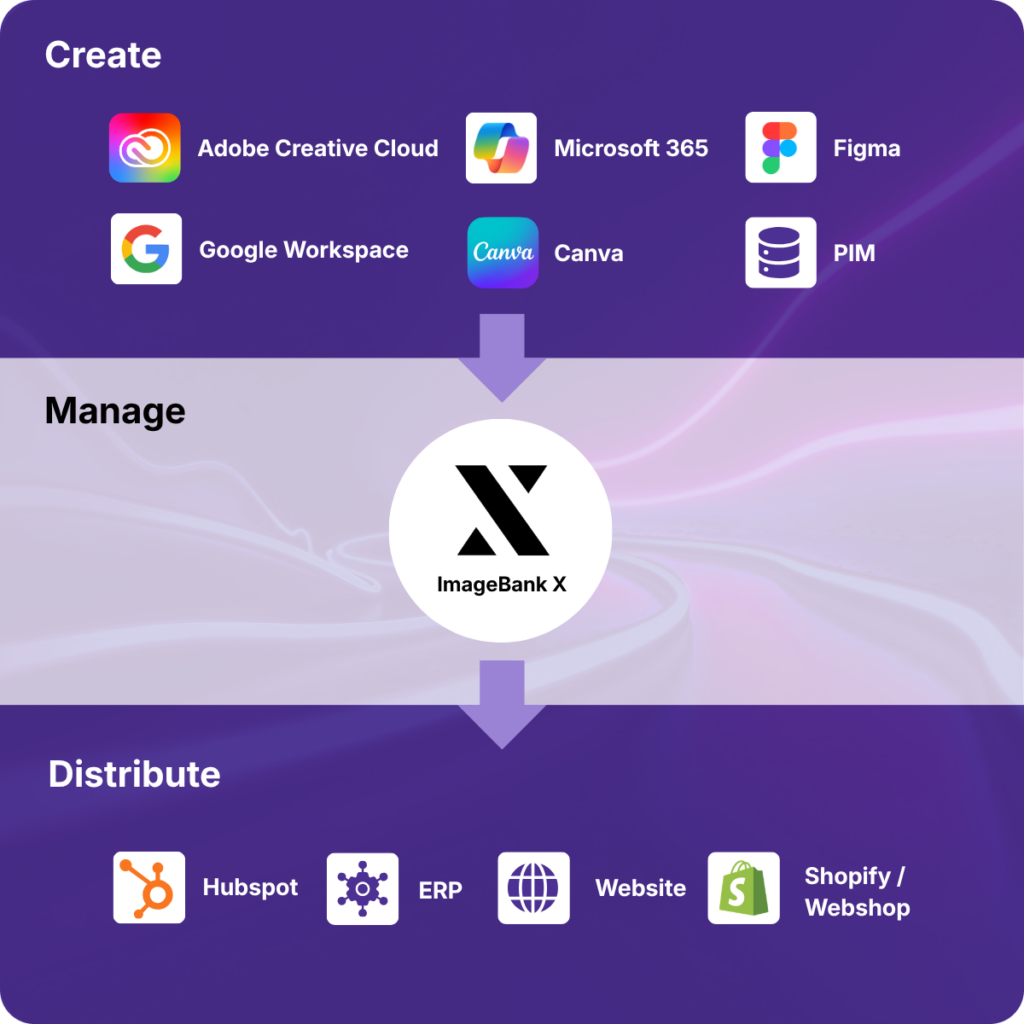
Integrating DAM into the wider digital ecosystem helps reduce repetitive tasks and enables more efficient content distribution. For example, a product image can be managed centrally in DAM and made available to connected channels without requiring employees to repeatedly download and upload the same file.
This improves efficiency while helping teams maintain consistent, up-to-date content across channels.
Ready to get more value from your digital assets?
The ROI of DAM isn’t simply about what the software can do. It’s about the inefficiencies your organization no longer has to pay for. With ImageBank X, organizations can centralize their digital assets, improve discoverability with AI-powered search and metadata enrichment, and connect content to the systems and channels where it’s needed. The result is a more efficient content lifecycle, from creation and management to reuse and distribution.
Discover how ImageBank X can help your organization reduce manual work, improve content reuse, and build more efficient content workflows.
Ready to get more value from your digital assets?
See how ImageBank X can save your team time, reduce costs, and maximize content value.